What Is the ICD-10 Code for Liver Cancer? Complete Guide
September 17, 2026
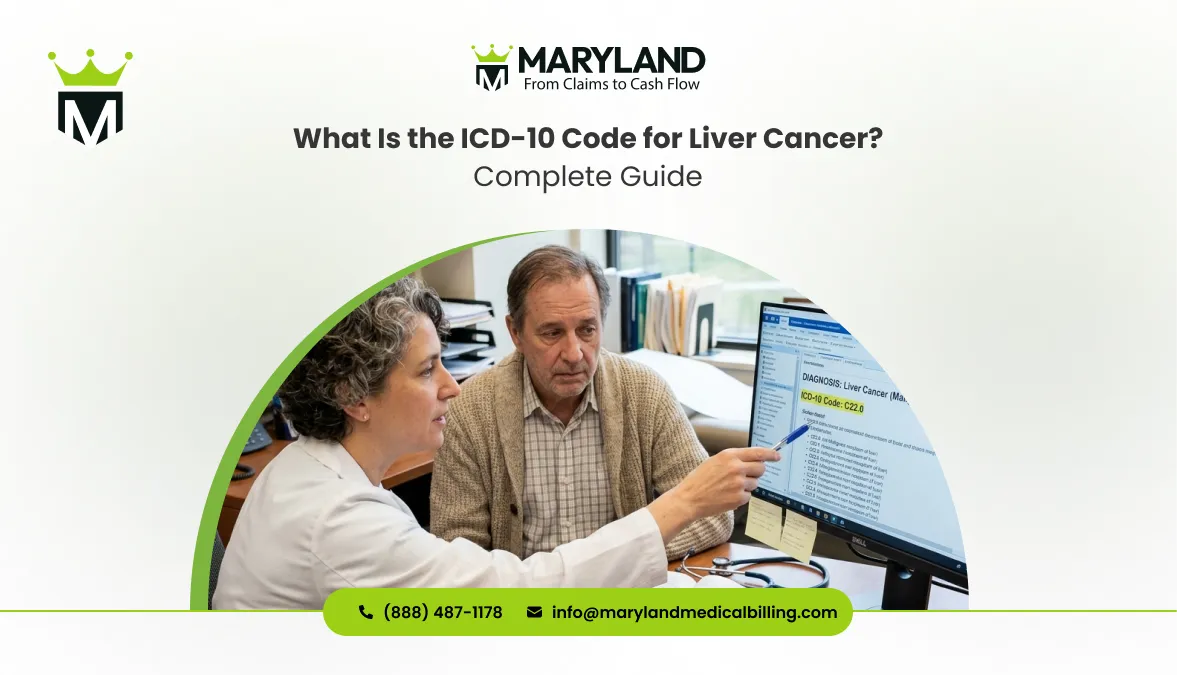
Liver cancer coding needs focus on the type of cancer and where it started. There is not one ICD-10-CM code that works for all liver cancer cases. The correct code depends on the type of cancer, where it is found if it started in the liver or came from another place and what the patients medical records say.
Cancers that start in the liver like carcinoma (HCC) intrahepatic bile duct carcinoma and hepatoblastoma have different codes in ICD-10-CM. When cancer moves to the liver from another place the code might be for a cancer to show the patients condition properly.
Getting the code right is important to link the diagnosis to the care given. It helps show that the care was needed makes claims process better and lowers the chance of delays or rejections.
This guide covers the ICD-10-CM codes used for liver cancer things to think about when coding diagnoses, the CPT and HCPCS codes involved what needs to be, in the records and issues that come up when billing and handling rejections that coders and billers should know.
Liver cancer is mainly grouped under the ICD-10-CM category C22.. There isn’t one single C22 code that fits all liver cancer cases.
The correct code must match the type of cancer that the provider has documented. Each case needs to be coded based on the malignancy found in the medical record.
For FY2026, the primary liver malignancy codes include:
| ICD-10-CM Code | Description |
|---|---|
| C22.0 | Liver cell carcinoma |
| C22.1 | Intrahepatic bile duct carcinoma |
| C22.2 | Hepatoblastoma |
| C22.3 | Angiosarcoma of liver |
| C22.4 | Other sarcomas of liver |
| C22.7 | Other specified carcinomas of liver |
| C22.8 | Malignant neoplasm of liver, primary, unspecified as to type |
| C22.9 | Malignant neoplasm of liver, not specified as primary or secondary |
CMSs FY2026 code data lists these codes within the liver malignancy category. C22.0 includes liver cell carcinoma, including carcinoma while C22.1 includes intrahepatic bile duct carcinoma.
C22.0 is used for the liver cell carcinoma. Hepatocellular carcinoma, commonly abbreviated as HCC, is included under this code.
When the d0ctor documents hepatocellular carcinoma of the liver, C22.0 is generally the relevant ICD-10-CM diagnosis code.
C22.1 represents malignant neoplasm of the intrahepatic bile duct.
This code covers cholangiocarcinoma. It is important to separate bile duct cancer from cancer of the extrahepatic bile duct because the extrahepatic bile duct malignancy falls into a different ICD-10-CM category.
C22.2 represents hepatoblastoma, a malignant liver tumor that occurs primarily in children.
It should not be used simply because a pediatric patient has a liver mass. The diagnosis must support hepatoblastoma.
C22.3 represents angiosarcoma of the liver.
This is a malignant tumor type so coders must rely on the documented diagnosis rather than, on the malignant tumor type assumed from imaging findings alone.
C22.4 represents other sarcomas of the liver.
The provider documentation should establish the applicable malignant diagnosis before assigning this code.
C22.7 is used for other specified carcinomas of the liver that are not classified under the more specific C22 codes.
C22.8 represents malignant neoplasm of the liver that is documented as primary, but the type is not specified.
This distinction is important. C22.8 should not automatically be used simply because a record says “liver cancer.” The documentation should support a primary liver malignancy.
C22.9 stands for neoplasm of the liver when the medical records do not say if the cancer started in the liver or spread from somewhere else.
Since knowing whether the cancer is primary or secondary can change the code coders must look over the whole medical record before choosing an unspecified code like C22.9.
One of the most important concepts in liver cancer coding is determining whether the liver is the primary site of the cancer.
Primary liver cancer begins in the liver. Hepatocellular carcinoma is one example.
Secondary liver cancer happens when cancer that started elsewhere spreads into the liver.
For a malignant tumor that touches the liver and the bile duct, inside the liver ICD-10-CM uses the code C78.7.
For example, suppose a patient has colon cancer that has metastasized to the liver. The liver lesion should not automatically be coded as primary liver cancer. The documentation should be reviewed to determine the primary malignancy and metastatic site.
The correct sequencing can also depend on the reason for the encounter. Under the FY2026 ICD-10-CM guidelines, when an encounter is for treatment of a primary malignancy, the primary malignancy is generally sequenced first. When treatment is directed only at a secondary malignant site, the secondary site may be sequenced first, with the primary malignancy reported additionally.
A practical liver cancer coding review can follow four basic steps.
Start with the provider’s documented diagnosis.
Do not automatically label every liver mass every lesion, every nodule or every abnormal imaging finding as malignant.
The record could instead mention a tumor, a neoplasm of uncertain behavior a cyst, an abnormal imaging finding or another condition.
The ICD-10-CM guidelines stress the importance of figuring out if a neoplasm is benign, in situ, malignant or of behavior before choosing the right code.
Next figure out if the cancer started in the liver or if it is cancer that has spread from another place in the body.
This difference can change the diagnosis code from the C22 group to a code for cancer, like C78.7.
Look for specific terminology such as:
A specific documented diagnosis is generally more useful for code selection than a nonspecific phrase such as “liver cancer.”
ICD-10-CM code sets are updated periodically. ICD-10-CM code sets must be checked by coding teams, for the date of service rather than using an old code list.
For FY2026, CMS and CDC provide the applicable ICD-10-CM code files and official guidelines.
In medical billing, DX code generally refers to the diagnosis code reported to explain the patient’s condition.
For liver cancer, commonly encountered ICD-10-CM diagnosis codes include:
C22.0 — Liver cell carcinoma
C22.1 — Intrahepatic bile duct carcinoma
C22.2 — Hepatoblastoma
C22.3 — Angiosarcoma of liver
C22.4 — Other sarcomas of liver
C22.7 — Other specified carcinomas of liver
C22.8 — Primary malignant neoplasm of liver, unspecified as to type
C22.9 — Malignant neoplasm of liver, not specified as primary or secondary
C78.7 — Secondary malignant neoplasm of liver and intrahepatic bile duct
The appropriate diagnosis code depends on what is actually documented and the reason for the encounter.
ICD-10-CM and CPT serve different purposes.
ICD-10-CM codes describe the diagnosis.
CPT codes describe many of the professional services and procedures performed.
There is therefore no single “CPT code for liver cancer.” The CPT code depends on what the physician or other qualified healthcare professional actually did.
Depending on the patient’s treatment, liver cancer claims may involve CPT codes associated with:
For example, a liver biopsy, a surgical liver resection, and an oncology follow-up visit are different services and therefore require different CPT coding.
Some liver-directed interventional procedures can also involve multiple codes for the procedure, catheter placement, imaging, or related services. The exact code selection depends on the technique, approach, documentation, and circumstances of the procedure.
Do not select a CPT code simply because the patient has liver cancer. The CPT code should describe the service actually performed.
Because CPT is kept by the American Medical Association and codes can be different each year coding teams need to check the CPT codebook for this year and the rules from each payer, before sending a claim.
The oncologist documents:
“Hepatocellular carcinoma of the liver.”
The diagnosis supports C22.0 — Liver cell carcinoma.
If the patient receives an oncology service, the claim would include the applicable CPT or HCPCS code for the service performed, along with the appropriate diagnosis code.
The medical record documents:
“Colon cancer with metastatic disease to the liver.”
The liver involvement represents secondary malignant disease rather than a new primary liver cancer. C78.7 may be applicable for the secondary malignant neoplasm of the liver and intrahepatic bile duct, while the primary colon malignancy should also be coded according to the documentation and encounter.
The provider documents:
“Primary malignant neoplasm of liver; histologic type not specified.”
When looking at the documentation you might find that C22.8 is the choice because C22.8 tells us that there is a primary cancer, in the liver but it does not say which kind of cancer it is.
If the documentation simply states:
“Malignant neoplasm of liver”
without establishing whether the malignancy is primary or secondary, C22.9 may be relevant.
However, coders should review the complete record and follow applicable coding guidelines and query procedures rather than automatically choosing an unspecified code.
Good documentation is one of the most important parts of accurate cancer coding.
Depending on the clinical situation, documentation may identify:
For example, “liver mass” provides less diagnostic information than a documented diagnosis of hepatocellular carcinoma.
When the documentation is incomplete, conflicting, or unclear, the coding team should follow its organization’s compliant provider-query process when appropriate.
Correct diagnosis coding is only one part of a clean oncology claim.
A typical liver cancer claim may involve:
Patient information → Insurance verification → Authorization → Documentation → ICD-10-CM diagnosis coding → CPT/HCPCS coding → Claim submission → Payment posting → Denial follow-up
The diagnosis should support the service being billed.
For example, a patient receiving chemotherapy may have a malignancy diagnosis along with the appropriate drug and administration codes. A patient undergoing liver-directed treatment may have diagnosis codes linked to procedure codes describing the actual service performed.
The claim also needs accurate patient demographics, insurance information, provider information, units, modifiers when applicable, authorization information, and other required claim data.
Even when the liver cancer diagnosis code is correct, a claim can still be denied.
Common problems include:
A metastatic liver lesion may be incorrectly reported as primary liver cancer.
Prevention: Review the oncology, pathology, operative, and other relevant documentation to establish the documented primary and secondary sites.
A nonspecific C22 code may be selected even though the provider documented a specific liver cancer type.
Prevention: Review the record for specific diagnostic terminology before selecting an unspecified code.
The diagnosis might be correct. It may not properly back the billed procedure according to the payers medical‑necessity rules.
Prevention: Check how the diagnosis, procedure, documentation and payer policy fit together before you send the claim.
Some cancer treatments, imaging scans, medicines and procedures may need authorization depending on the patients insurance plan.
If prior authorization is required and not obtained the claim may be denied.
Prevention: Verify benefits and authorization requirements before providing services when required by the payer.
A payer may ask for clinical documentation to check if the service meets its coverage rules.
Prevention: Make sure the medical record clearly supports the service. Also confirm that all needed paperwork is ready and available, for submission.
Incorrect CPT codes, modifiers, units or other claim information can cause the claim to be rejected or denied.
Prevention: Do a review of coding and billing at the claim level before sending it in.
Even a claim that is coded correctly can become unpayable if it is sent after the payer’s filing deadline.
Prevention: Keep track of the timely-filing rules, for each payer. Make sure claims are submitted on time.
A practical pre-submission checklist can help billing teams catch problems early:
Diagnosis: I ask whether the ICD-10-CM code accurately represents the documented malignancy.
Primary, vs. Secondary: I check whether the liver tumor is primary or metastatic.
Documentation: I verify that the medical record supports the diagnosis and the service.
CPT/HCPCS: I confirm whether the procedure and service codes accurately describe what was performed.
Authorization: Was prior authorization required and obtained?
Medical necessity: Does the documentation support the billed service?
Modifiers and units: Are they correct and supported?
Insurance: Is the patient’s coverage active?
Timely filing: Is the claim being submitted within the payer’s deadline?
This type of review can identify preventable issues before they turn into denials.
Cancer coding can change depending on the purpose of the encounter.
For example, an oncology visit may involve active treatment, surveillance, follow-up after completed treatment, management of complications, or treatment of metastatic disease.
The coding team should determine what the encounter is actually for instead of automatically reporting the same diagnosis on every claim.
The FY2026 ICD-10-CM guidelines contain specific guidance for encounters involving treatment of primary malignancies, secondary malignancies, complications associated with neoplasms, chemotherapy, immunotherapy, radiation therapy, and follow-up care.
The answer to “What is the ICD-10 code for liver cancer?” depends on what the medical record actually documents.
For FY2026, C22.0 represents liver cell carcinoma, C22.1 represents intrahepatic bile duct carcinoma, C22.2 represents hepatoblastoma, C22.3 represents angiosarcoma of the liver, C22.4 represents other liver sarcomas, C22.7 represents other specified carcinomas, C22.8 represents primary malignant neoplasm of the liver unspecified as to type, and C22.9 represents malignant neoplasm of the liver not specified as primary or secondary. C78.7 is used for secondary malignant neoplasm of the liver and intrahepatic bile duct.
Accurate liver cancer coding requires more than finding the word “cancer” in a patient’s chart. The coding team should determine the documented cancer type, establish whether the liver is the primary site or a metastatic site, review supporting documentation, and select the diagnosis code applicable to the encounter.
The diagnosis code is only one piece of the claim. CPT and HCPCS coding, authorization, medical necessity, documentation, insurance eligibility, modifiers, units, timely filing, and payer-specific requirements can all affect claim processing.
A careful review from documentation to diagnosis coding to procedure coding to claim submission and denial follow-up can help create a more consistent medical billing workflow and reduce avoidable claim problems.
Liver cancer is classified primarily under ICD-10-CM category C22, but the exact code depends on the type and documentation. C22.0 is used for liver cell carcinoma, while other C22 codes identify different primary liver malignancies.
The ICD-10-CM code for hepatocellular carcinoma is C22.0 — Liver cell carcinoma.
C78.7 represents secondary malignant neoplasm of the liver and intrahepatic bile duct.
C22 is an ICD-10-CM category. The specific diagnosis code should be selected from the applicable C22 subcategories based on the documentation.
C22.8 represents malignant neoplasm of the liver, primary, unspecified as to type.
C22.9 represents malignant neoplasm of the liver when the malignancy is not specified as primary or secondary.
No. CPT codes describe the services and procedures performed, not the cancer diagnosis itself. The CPT code depends on the specific service, such as biopsy, surgery, imaging, ablation, interventional treatment, or oncology care.
Not automatically. A liver mass does not necessarily mean malignant disease. The diagnosis should be based on the provider’s documentation and applicable ICD-10-CM coding rules.