ICD-10 Code for Left Hip Pain: Complete Coding and Billing Guide
November 25, 2026
Left hip pain has an ICD-10 code of M25.552. Providers will use this code in documenting pain in the left hip without making a further diagnosis of the condition.
Coding hip pain might appear easy at first glance; however, errors such as improper laterality, insufficient documentation, the misuse of modifiers, and wrong diagnosis procedure pairings can result in denials. Knowing when to code M25.552 and when to choose a better diagnosis is important.
This guide from Maryland Medical Billing covers left hip pain ICD-10 codes, documentation requirements, related CPT codes, practical coding scenarios, and billing strategies to prevent avoidable denials.
The ICD-10-CM code M25.552 is the code for pain in the left hip. It falls under the joint disorders, which healthcare providers apply when reporting musculoskeletal diseases.
M25.552 is a valid and billable ICD-10-CM code, available from October 1, 2026, until September 30, 2027, within the FY 2027 ICD-10-CM code set.
|
Coding information |
Details |
|---|---|
|
ICD-10-CM code |
M25.552 |
|
Official description |
Pain in left hip |
|
Category |
M25 – Other joint disorders |
|
Subcategory |
M25.55 – Pain in hip |
|
Laterality |
Left |
|
Billable code |
Yes |
|
Classification |
Musculoskeletal disorders |
|
Encounter character required |
No |
M25.552 can be used for outpatient consults, orthopedic assessments, diagnostics studies, and physical therapy visits, provided that the documented condition qualifies for the code.
However, a billable diagnosis code is no proof of medical necessity and does not ensure reimbursement.
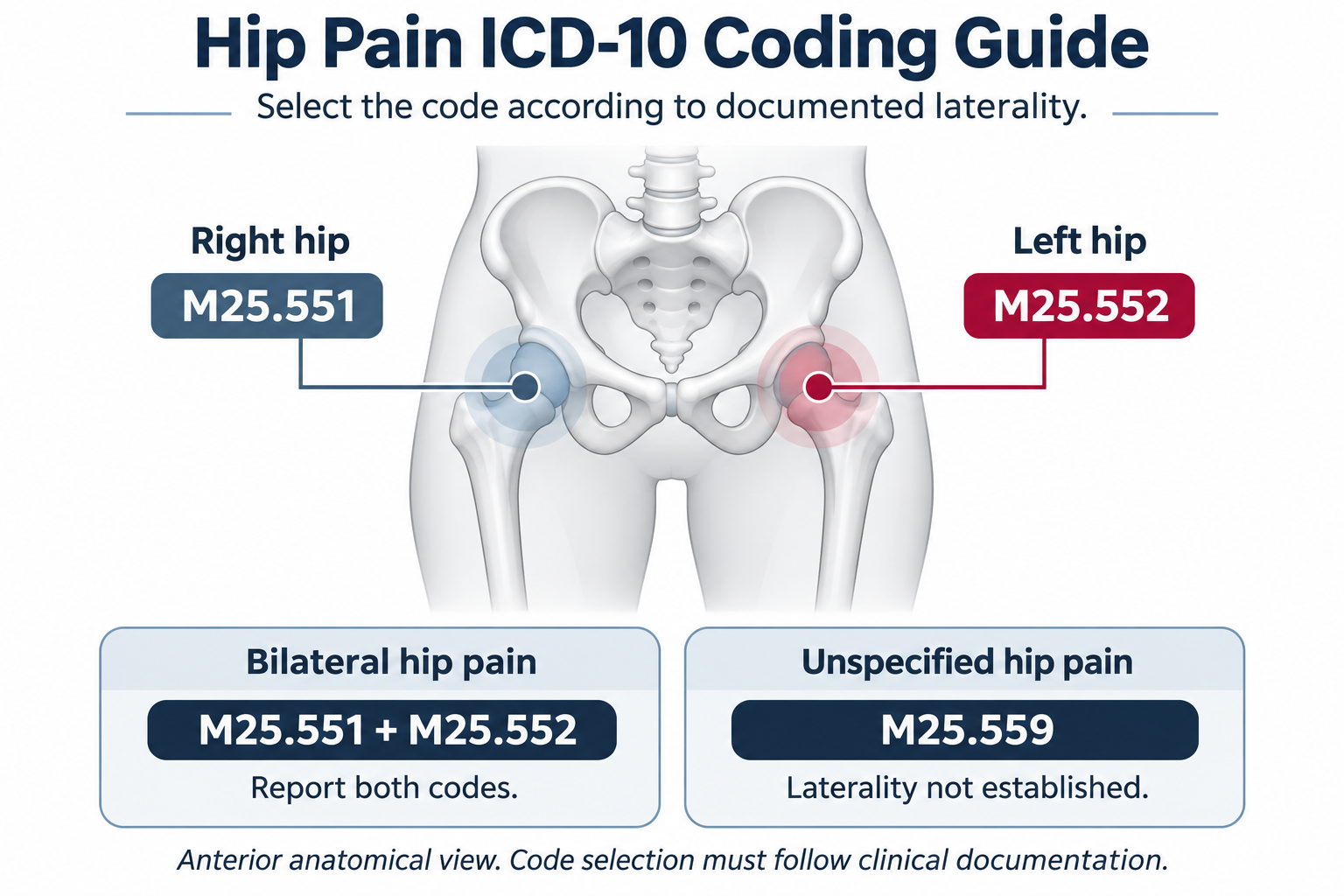
Laterality plays an important role in hip pain coding. Providers must clearly identify the affected hip to help coding teams select the appropriate diagnosis.
|
ICD-10 code |
Description |
|---|---|
|
M25.551 |
Pain in right hip |
|
M25.552 |
Pain in left hip |
|
M25.559 |
Pain in unspecified hip |
|
M25.551 + M25.552 |
Bilateral hip pain |
No bilateral hip pain code is available in ICD-10-CM for this subcategory. Assign codes for both right and left hip pain where there are bilateral symptoms and no other specific diagnosis is made.
Do not use the unspecified hip pain code when the laterality of the symptom is known.
Providers should report M25.552 when the patient experiences left hip pain and the medical record supports symptom-based coding.
Common clinical situations include:
Initial evaluation of unexplained left hip pain.
Hip discomfort during walking or weight-bearing activities.
Persistent hip pain without an established underlying diagnosis.
Diagnostic imaging to investigate hip joint symptoms.
Physical therapy for documented left hip pain.
Outpatient assessment of suspected musculoskeletal conditions.
For instance, a patient comes to an orthopedic specialist due to chronic left hip pain. The doctor performs an X-ray in order to diagnose possible osteoarthritis but he does not diagnose the condition.
The code M25.552 is used to properly document the symptom presented in this case of out-patient care.
ICD-10-CM official coding guidelines advise to use only the established findings and not to assume diagnoses for suspected or probable conditions.
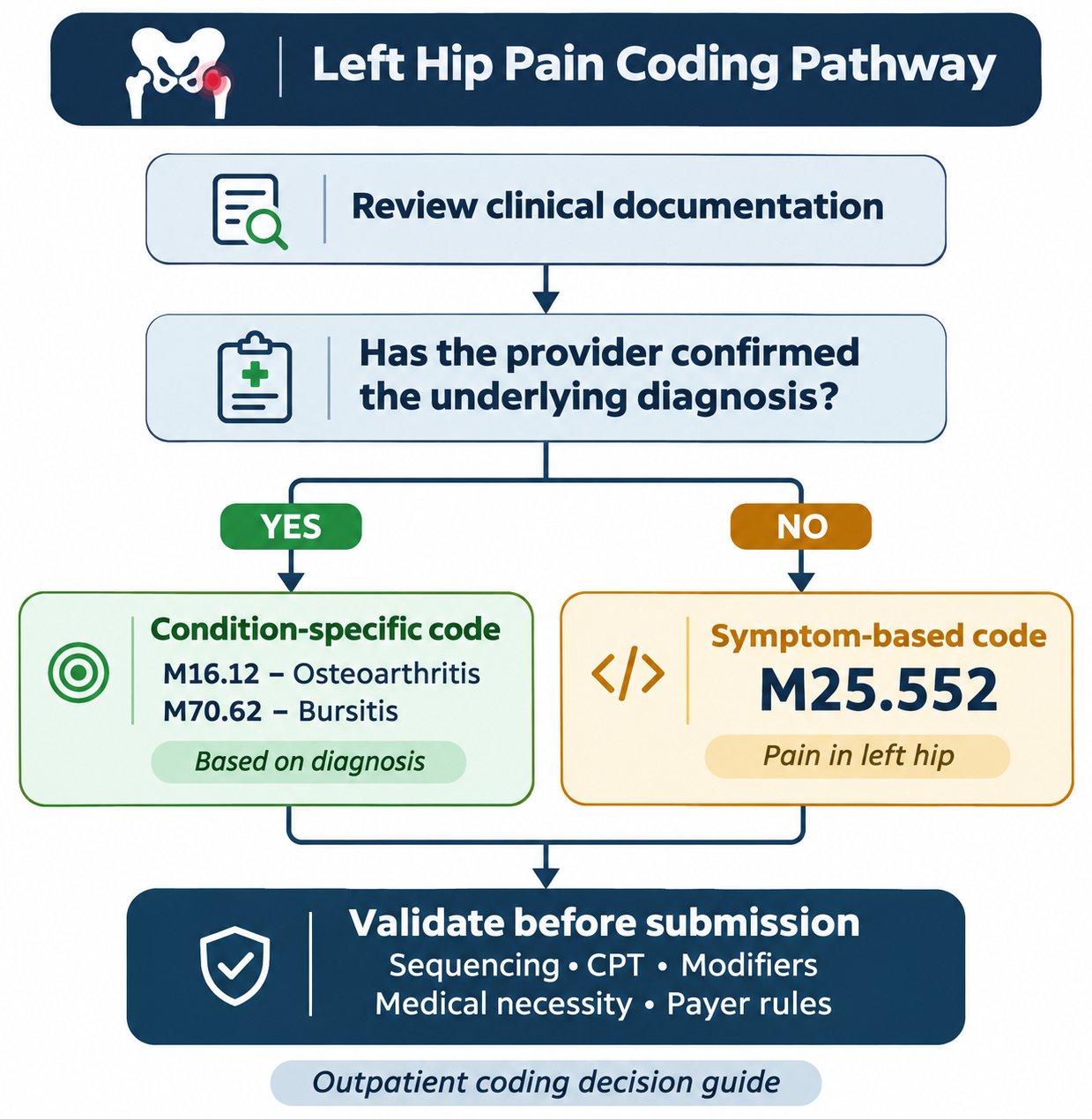
Left hip pain does not always justify reporting M25.552. When a physician establishes an underlying condition that explains the symptoms, coding teams should generally report that condition instead.
Avoid using M25.552 as a substitute for a confirmed diagnosis involving:
Hip osteoarthritis
Hip fractures and traumatic injuries
Trochanteric bursitis
Gluteal tendinitis
Hip joint infections
Avascular necrosis
Prosthetic hip complications
Do not separately report hip pain when it represents a routine symptom of the confirmed condition, unless applicable coding instructions support separate reporting.
Healthcare providers frequently encounter musculoskeletal conditions that require more specific diagnosis codes than M25.552.
|
ICD-10 code |
Description |
|---|---|
|
M25.552 |
Pain in left hip |
|
M25.652 |
Left hip stiffness, not elsewhere classified |
|
M25.452 |
Effusion, left hip |
|
M25.352 |
Other instability, left hip |
|
M25.052 |
Hemarthrosis, left hip |
|
M16.12 |
Unilateral primary osteoarthritis, left hip |
|
M16.52 |
Unilateral post-traumatic osteoarthritis, left hip |
|
M70.62 |
Trochanteric bursitis, left hip |
|
M76.02 |
Gluteal tendinitis, left hip |
|
M76.12 |
Psoas tendinitis, left hip |
|
M87.052 |
Idiopathic aseptic necrosis of left femur |
|
M54.32 |
Sciatica, left side |
|
G89.29 |
Other chronic pain |
|
Z96.642 |
Presence of left artificial hip joint |
The following codes stand for distinct medical conditions, and not interchangeable choices. The diagnoses should always be verified in accordance with the information provided by the physician, along with the guidelines of the table.
For instance, M16.12 identifies primary osteoarthritis, while M70.62 identifies trochanteric bursitis.
Providers may use M25.552 alongside G89.29 when the documentation establishes chronic left hip pain and the additional code provides relevant information about the pain.
However, sequencing depends on the purpose of the encounter.
|
Encounter purpose |
Coding approach |
|---|---|
|
Evaluation of chronic left hip pain |
M25.552 followed by G89.29, when appropriate |
|
Dedicated chronic pain management |
G89.29 followed by M25.552, when appropriate |
|
Treatment of confirmed hip osteoarthritis |
Report the established osteoarthritis diagnosis |
|
Chronic pain syndrome |
Consider G89.4 only when the provider specifically documents the syndrome |
Coding personnel must avoid assuming that hip pain which is long-lasting must be categorized under chronic pain.
In the same vein, chronic pain and chronic pain syndrome have their distinct clinical connotations in terms of coding.
Hip pain following an accident or surgical procedure requires additional coding attention. Reporting M25.552 alone may fail to describe the patient’s actual condition.
When the physician confirms a fracture, dislocation, sprain, or another traumatic injury, report the corresponding injury code.
Verify the following details:
Injury type and anatomical location
Affected side
Encounter phase
Healing status, where applicable
Associated injuries
If an outpatient evaluation does not establish a specific injury, symptom-based coding may remain appropriate.
Post-operative pain is possible after hip replacement surgery. However, it is important to differentiate between post-operative pain and any complications that are reported.
The code Z96.642 describes the situation when there is a left artificial hip joint. When the physician can establish a relationship between pain and the prosthetic joint, T84.84XA can be used along with other codes as needed.
It cannot be automatically assumed that the patient’s pain is associated with a complication related to a prosthesis.
Discomfort to the hip which then moves down to the lower extremity may be related to conditions such as sciatica or lumbar radiculopathy.
Code M54.32 can be applied only to left-sided sciatica if and when the diagnosis is established by the healthcare practitioner.
The following decision guide helps billing teams distinguish symptom-based coding from condition-specific reporting.
ICD-10-CM provides a description for the health problem of the patient, while CPT codes explain the medical procedures performed by medical professionals.
The following medical procedure codes might be used in orthopedics practices, physical therapy, pain management practices, and diagnostic imaging centers.
|
CPT code |
Service description |
|---|---|
|
99202–99205 |
New patient office visits |
|
99212–99215 |
Established patient office visits |
|
73501 |
Unilateral hip X-ray, one view |
|
73502 |
Unilateral hip X-ray, two to three views |
|
73503 |
Unilateral hip X-ray, four or more views |
|
73721 |
Lower extremity joint MRI without contrast |
|
73722 |
Lower extremity joint MRI with contrast |
|
20610 |
Major joint or bursa aspiration/injection without ultrasound guidance |
|
20611 |
Major joint or bursa aspiration/injection with ultrasound guidance |
|
27093 |
Hip arthrography contrast injection without anesthesia |
|
97161–97163 |
Physical therapy evaluation |
|
97164 |
Physical therapy reevaluation |
|
97110 |
Therapeutic exercises |
|
97140 |
Manual therapy |
|
97530 |
Therapeutic activities |
|
27130 |
Total hip arthroplasty |
No. Even if M25.552 is useful for some diagnoses, imaging studies, and conservative treatment options, more advanced treatments might need further clinical proof or a definite diagnosis.
For instance, a hip replacement procedure will need confirmation of the condition that caused the need for the surgery. Please read the applicable Medicare policies concerning hip replacement billing and coding.
Incorrect modifier usage can create claim discrepancies even when the diagnosis and procedure codes are accurate.
|
Modifier |
Application |
|---|---|
|
LT |
Identifies a procedure performed on the left side |
|
RT |
Identifies a procedure performed on the right side |
|
50 |
Bilateral procedure, when eligible |
|
25 |
Significant, separately identifiable E/M service |
|
59 |
Distinct procedural service, when justified |
|
GP |
Services under a physical therapy plan of care |
|
26 |
Professional component of an eligible service |
|
TC |
Technical component of an eligible service |
|
KX |
Applicable coverage requirements have been satisfied |
The procedure coding M25.552 already includes information related to laterality. However, some procedure codes may require the addition of the LT modifier due to specific requirements of the payer.
Prior to submission of multiple procedures done during one encounter, billers should check CMS National Correct Coding Initiative Edits.
Never add any modifiers to bypass the claim edits.
Accurate coding starts with complete clinical documentation. A medical record that only states “hip pain” may not provide enough information to support the diagnosis, treatment, or billed procedure.
|
Documentation element |
Billing significance |
|---|---|
|
Pain location and laterality |
Supports accurate diagnosis selection |
|
Onset and duration |
Helps distinguish acute and chronic conditions |
|
Injury history |
Supports trauma-related coding |
|
Physical examination findings |
Establishes relevant clinical evidence |
|
Functional limitations |
Supports rehabilitation medical necessity |
|
Diagnostic findings |
Helps establish underlying pathology |
|
Previous treatment |
Supports coverage reviews when required |
|
Treatment plan |
Justifies the services performed |
|
Provider assessment |
Establishes the reportable diagnosis |
For physical therapy visits, practitioners should also record quantifiable functional deficits, therapeutic goals, skilled interventions, duration of treatment, and patient progress towards recovery.
Review applicable Medicare physical and occupational therapy billing guidance alongside individual payer requirements.
A patient reports left hip pain that worsens during walking. The orthopedic physician performs an evaluation and orders a three-view X-ray. The physician does not establish an underlying diagnosis.
|
Claim element |
Code |
|---|---|
|
Diagnosis |
M25.552 |
|
Hip X-ray |
73502 |
|
Laterality modifier |
LT, when required |
Report an appropriate E/M code when the documented service and billing circumstances support it.
A physician reviews imaging findings and establishes primary osteoarthritis of the left hip.
|
Claim element |
Code |
|---|---|
|
Confirmed diagnosis |
M16.12 |
|
Additional routine hip pain code |
Generally unnecessary |
The established diagnosis replaces symptom-based coding when it explains the patient’s pain.
The physical therapist assesses the client who has left hip pain and limited functional mobility. The physical therapist conducts therapy exercises in a follow-up therapy session.
|
Claim element |
Code |
|---|---|
|
Diagnosis |
M25.552 |
|
Therapeutic exercises |
97110 |
|
Therapy modifier |
GP, when applicable |
Report treatment units according to documented treatment time and the payer’s timed-code methodology.
A physician diagnoses left trochanteric bursitis and performs a therapeutic bursa injection without ultrasound guidance.
| Claim element |
Code |
|---|---|
|
Diagnosis |
M70.62 |
|
Injection procedure |
20610 |
|
Laterality modifier |
LT, when required |
Report the administered medication separately only when applicable billing and coverage rules permit it.
A valid ICD-10 code does not necessarily result in a successful claim. Many payment delays arise from inconsistencies between clinical records, procedure codes, and payer requirements.
Reporting right hip pain when the medical record identifies the left hip creates a diagnosis mismatch.
Solution: Cross-check the diagnosis, procedure modifier, imaging order, and treatment notes.
A payer may deny advanced imaging, injections, or rehabilitation services when the documentation does not justify the intervention.
Solution: Document relevant examination findings, functional limitations, and clinical reasoning.
Certain insurance plans require authorization for MRI scans, joint injections, surgery, or extended physical therapy.
Solution: Verify authorization requirements before performing scheduled services.
Incorrect use of modifiers 25, 59, or LT may trigger claim edits or payment reviews.
Solution: Confirm that documentation and payer policies support each modifier.
Continuing to report M25.552 after a physician establishes an underlying diagnosis may reduce coding specificity.
Solution: Update diagnosis coding as the clinical assessment changes.
Physical therapy claims may contain discrepancies between reported units and documented treatment time.
Solution: Reconcile timed services, treatment minutes, and payer-specific unit calculations.
Practices experiencing recurring payment issues can benefit from structured medical billing denial management services that identify and address the underlying causes of rejected and denied claims.
|
Denial code |
Common issue |
Recommended action |
|---|---|---|
|
CO-16 |
Missing or incorrect claim information |
Review associated remark codes and correct the claim |
|
CO-50 |
Medical necessity requirements not met |
Review clinical evidence and coverage criteria |
|
CO-97 |
Service included in another procedure |
Check bundling rules and applicable modifiers |
|
CO-197 |
Missing authorization or precertification |
Review authorization records and appeal options |
|
CO-11 |
Diagnosis inconsistent with procedure |
Validate diagnosis-to-procedure compatibility |
|
CO-29 |
Filing deadline exceeded | Review submission records and timely filing requirements |
Always review the complete electronic remittance advice, including associated remark codes, before correcting or appealing a denied claim.
Use this checklist before releasing orthopedic, physical therapy, or pain management claims.
Orthopedic practices in Maryland, rehab centers and pain management centers manage claims in both Medicare, Medicaid in Maryland, and commercial insurance plans.
Each payor will have different requirements related to referral, authorization, diagnostic images, therapy limitations and procedures coverage.
Before submitting claims, billing teams should review:
Provider participation and network status.
Patient-specific coverage and benefits.
Referral and authorization requirements.
Procedure-specific reimbursement policies.
Current fee schedules and filing deadlines.
Providers can consult the Maryland Medicaid fee schedule guide for additional reimbursement considerations, while confirming the current official schedule for the date of service.
ICD-10 code for left hip pain supported by clinical documentation would be M25.552. However, it is important to understand the difference between unexplained hip pain and hip pain caused by musculoskeletal disorders, trauma, chronic pain, and postoperative care.
Choosing the right diagnosis, applying appropriate modifiers, documenting all the details, and checking claims by specific payers could help avoid unnecessary denials.
No longer let coding errors, authorization problems, and frequent denials disrupt your revenue cycle process. We at Maryland Medical Billing can assist orthopedics and rehab practices with coding accuracy, claim processing, and collections.
The ICD-10-CM code for left hip pain is M25.552. The code is assigned when there is evidence in the documentation to support pain in the left hip without any further diagnosis.
Yes. M25.552 is a billable ICD-10-CM code that can be used to code a diagnosis with reimbursement being contingent on medical necessity and other factors.
Code M25.551 is used for right hip pain while M25.552 is used for left hip pain when the documentation describes bilateral hip pain.
Yes, if there is clinical documentation that the patient suffers from chronic left hip pain and these two codes are relevant. Purpose of the encounter is determining sequencing.
M16.12 refers to unilateral primary osteoarthritis of the left hip. Codes for other types of hip arthritis depend on the documented cause.
Yes. Physical therapists are able to report M25.552 if there is supporting clinical documentation. The documentation should also indicate functional limitations, need for skilled treatment, and medical necessity.
