CMS 2027 Medicare Physician Fee Schedule: Key Changes Providers Need to Know
November 6, 2026
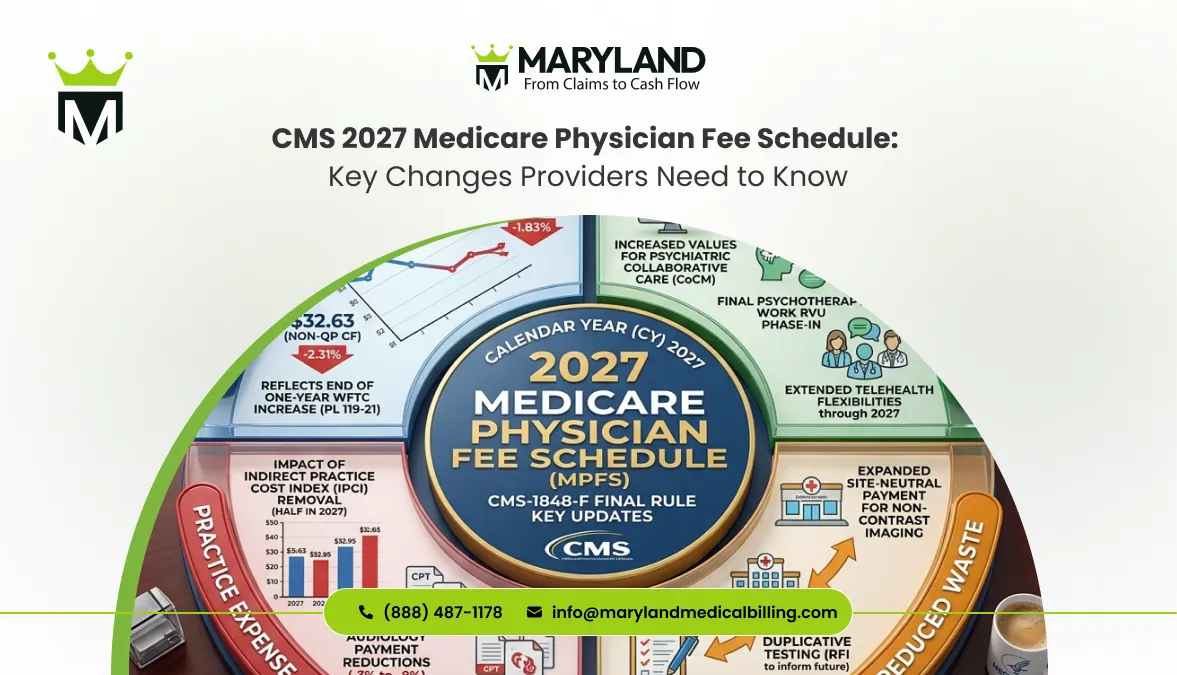
The 2027 CMS Medicare Physician Fee Schedule marks major shifts in the way physicians and other medical professionals will be paid for Medicare Part B services. This can have an impact on practice income, clinical notes, and administration of the practice.
The CMS-1848-F – Calendar Year 2027 Medicare Physician Fee Schedule Final Rule was issued on November 4, 2026, by the Centers for Medicare & Medicaid Services (CMS).
Some of the major revisions done by CMS are reductions in the Medicare payments conversion factor. The final conversion factor was $32.63 for non-qualifying participants and $32.95 for the qualifying participants of alternative payment model. Other changes include the introduction of E/M modifiers, changes to policies on billing of the same day procedures, remote monitoring codes, and preventive care payments.
Such information is very crucial to physicians, billing specialists, and administrators within medical practices. Below is an article explaining how the changes will look like, what the impacts could be, and how they can be prepared for by 2027.
The Medicare Physician Fee Schedule (PFS) states how the physicians and eligible practitioners are paid by Medicare for the covered services rendered through Medicare Part B.
As per CMS, this schedule is applied for determining the payment rate for different services like office visits, diagnostics, therapy, behavioral health care services, etc.
Medicare calculates most PFS payments using three major components:
Work Relative Value Units (wRVUs): Reflect the physician’s time, effort, and clinical expertise.
Practice Expense RVUs: Account for resources such as staff, supplies, equipment, and operating expenses.
Malpractice RVUs: Reflect professional liability expense.
After this, geographic adjustments, as well as the applicable conversion factor, are used by CMS to calculate payment.
These adjustments are revised each year via the PFS final rule.
|
Policy Area |
Finalized 2027 Change |
|---|---|
|
Non-qualifying APM conversion factor |
$32.63 |
|
Qualifying APM conversion factor |
$32.95 |
|
Non-QP conversion factor change |
-2.31% from 2026 |
|
QP conversion factor change |
-1.83% from 2026 |
|
E/M complexity add-on |
G2211 replaced by modifier B1 |
|
ACO E/M complexity payment |
New modifier B2 |
|
Same-day E/M with 0-day global procedures |
100% payment for highest-priced service; 80% for other applicable services |
|
Remote monitoring |
New initiation, patient relationship, and valuation policies |
|
Remote monitoring staff employment requirement |
Delayed until January 1, 2029 |
|
Practice expense methodology |
Two-year transition away from IPCI |
|
Advance care planning |
New HCPCS codes G0572 and G0573 |
|
Shared medical appointments |
Separate coding and payment finalized |
|
Main effective date |
January 1, 2027 |
The most obvious financial change pertains to Medicare conversion factors which are responsible for calculating payments of physicians.
In 2027, CMS established two separate conversion factors, similar to the previous year when a distinction was drawn between “qualifying APM participants and other clinicians.
This is mainly attributed to the expiration of the temporary 2.5% boost in physician payments made available for 2026 by Public Law 119-21.
While there are positive adjustments in the legislation for 2027—0.75% for APM participants and 0.25% for other clinicians—the aforementioned adjustment is more than enough to compensate for the expiration of the temporary boost.
The CMS also makes budget neutrality adjustments amounting to -0.12% due to the change in the work RVUs.
As a result, both finalized conversion factors are lower than their 2026 counterparts.
A reduction in the conversion factor would mean less reimbursement for some services despite the fact that the physicians would be performing the same clinical activities.
But not all CPT codes will face an equivalent payment cut since RVUs, practice expense, geographic adjustment, and specific policies for each service might yield varying results.
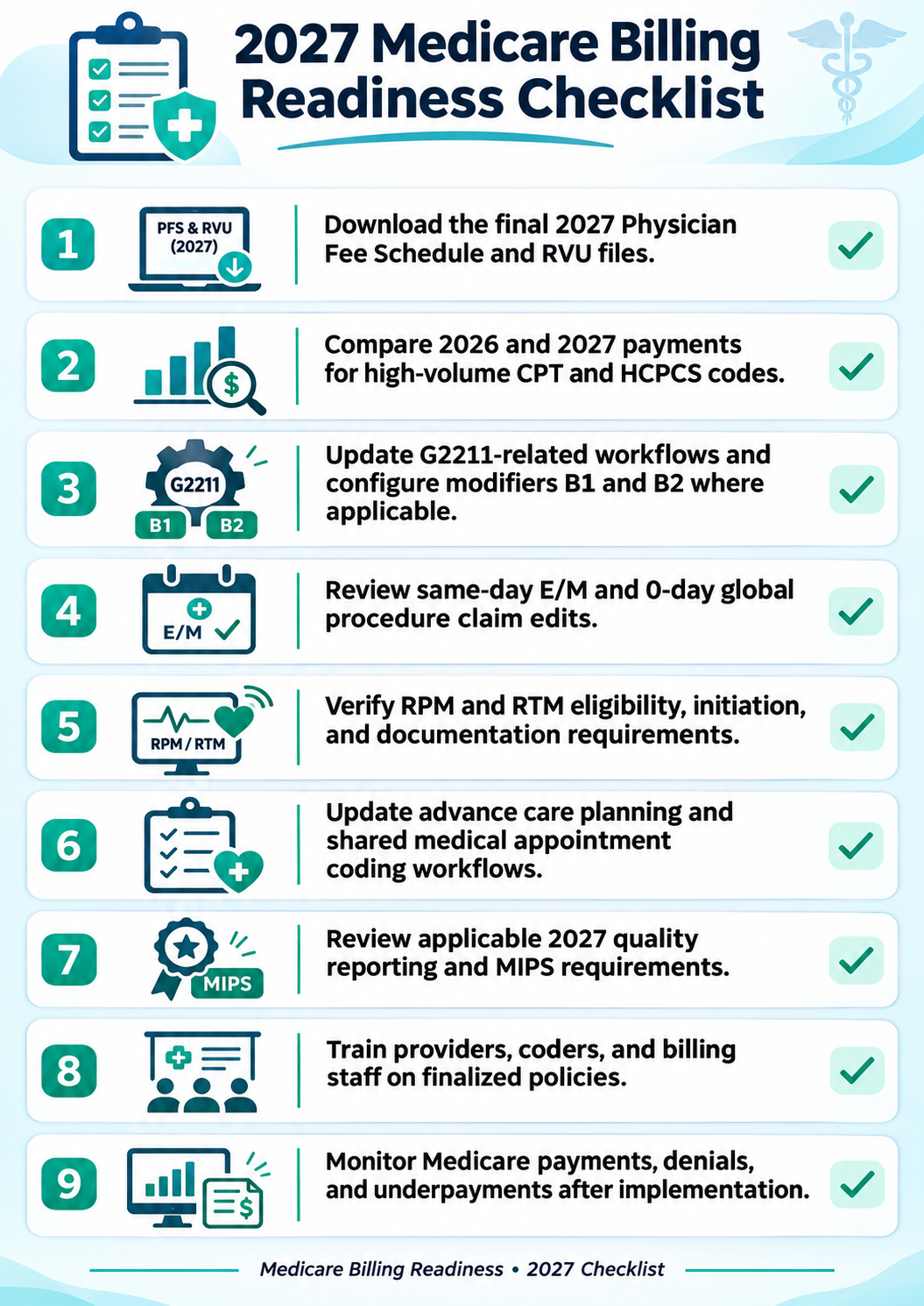
Action by providers: It is recommended that the Medicare payments for the CPT and HCPCS codes that are billed most frequently by the providers’ practices be compared for the year 2026 and 2027.
The other major modification is related to the issue of complex evaluation and management visits.
Before, there was a provision for physicians who were eligible to report HCPCS code G2211 as a modifier that reflected the extra complexity involved in managing patients in a longitudinal manner.
For the year 2027, CMS has finalized the new way of reporting the code G2211 through modifier B1.
The B1 modifier will result in an extra payment of 16% for any eligible associated E/M encounter.
Rather than coding a separate add-on service, the modifier will be added to the E/M base code that is eligible.
The intention behind this modification is to make the payment consistent with the encounter’s complexity level.
CMS also approved the use of modifier B2 for eligible providers who participate in certain Accountable Care Organizations.
The use of this modifier would add 32% to the payment of an eligible E/M visit.
It can only be used by eligible providers participating in the Medicare Shared Savings Program ACOs or LEAD Model ACOs.
CMS chose to make B2 reporting optional under these certain programs and additional rules were created.
This practice of continuing to submit G2211 for 2027 encounters via the previous reporting process should be discontinued.
Rather, billing departments need to modify their claim forms, modifier codes, patient eligibilities, and payer-specific instructions for billing.
The documentation needs to back up the E/M services provided, along with the criteria for the use of the modifier.
The following changes have special significance for primary care physicians and internal medicine physicians.
There may be cases when a physician provides a separately identifiable evaluation and management service on the day of the procedure.
In the past, coding such encounters entailed careful review of global surgery package guidelines and supporting documentation for any separate E/M service provided.
For the year 2027, there is a new Medicare payment adjustment that will apply to appropriate encounters performed on 0-day global procedures.
Under the finalized policy, when a separately identifiable office or outpatient E/M visit occurs on the same day as a 0-day global procedure performed by the same physician or a physician in the same practice:
The highest-priced applicable service receives 100% payment.
Other applicable procedure or E/M services receive 80% payment.
CMS originally proposed a broader policy involving 0-, 10-, and 90-day global procedures with a larger payment reduction.
After reviewing public comments, CMS narrowed the finalized policy to 0-day global procedures and changed the secondary-service payment percentage from the proposed 50% to 80%.
Consider a hypothetical encounter involving two separately payable services.
|
Service |
Illustrative Unadjusted Amount |
Illustrative Adjusted Amount |
|---|---|---|
|
Higher-priced service |
$150 |
$150 |
|
Other qualifying service |
$100 |
$80 |
|
Total |
$250 |
$230 |
This example illustrates the 100%/80% calculation only. It does not represent actual Medicare rates, establish when two services may be billed, or account for other applicable adjustments.
It is important to make sure that there is proper documentation to support not only the E/M service but also the modifier (if applicable). It is especially important to check whether there is a 0-day global period for the procedure in question before implementing the new reimbursement policy.
This issue can be especially critical for dermatologists, minor surgeries, and other specialists performing interventions in the office setting.
Telehealth monitoring enables care providers to track selected data on patient health status between face-to-face visits.
The CMS rule in 2027 outlines updated requirements for remote physiologic monitoring (RPM) and remote therapeutic monitoring (RTM).
The CMS made some changes to better define patient eligibility, initiation of services, and payment methodologies.
For 2027, CMS finalized:
A requirement to provide RTM services only to established patients.
A separately reportable initiating visit associated with starting RPM or RTM services.
Changes to the valuation of remote monitoring services.
However, CMS delayed another proposed requirement.
The agency had proposed limiting payment to monitoring services performed by clinical staff employed directly by the billing practice.
Following stakeholder feedback, CMS delayed implementation of this employment requirement until January 1, 2029.
Practices which have the capability to remotely monitor should consider the way in which services are delivered, the documentation of patient relationships, and the clinical activities that occur during the process.
It would be wise to look at any contracts with third-party monitoring services prior to the postponed employment policy taking effect.
The delay does not affect the other 2027 policies which are now final.
It is imperative that practices separate the 2027 policies from the employment policy set for 2029.
Physician Fee Schedule considers cost factors like labor, machinery, materials, rent, and administrative expenses.
In many specialties, these costs account for a considerable amount of total expenses.
CMS is bringing changes to the formula that calculates indirect practice expenses payments.
The 2027 final rule begins a two-year phaseout of the indirect practice cost index (IPCI), which relies on older specialty-specific expense assumptions.
This will be replaced by a practice expense stabilizer that aims at reducing the short-term fluctuations without permanently tying the payment formulas to the historical expenses.
Other changes finalized by the CMS include adjustments to the allocation of indirect practice expenses (with an exception of certain global surgical services).
Different specialties have different resource requirements.
A diagnostic practice that relies heavily on equipment and clinical staff may experience a different payment impact from a consultation-based physician practice.
CMS aims to improve the accuracy of practice expense calculations, but the actual effect will vary by specialty and service.
Providers should review the published 2027 RVU files and compare reimbursement for high-volume procedures.
Practices should also monitor potential differences between facility and non-facility payments.
This new regulation of 2027 also includes some additional rules for Medicare payments that have been established for the purpose of enabling preventive treatment and disease management.
These modifications will be particularly useful for family practitioners, behavioral health practitioners, and practitioners who provide treatment to patients suffering from several diseases.
CMS provided a coding and payment structure for shared medical appointments including an add-on code which acknowledges increased service time.
Shared medical appointments make it possible for eligible patients to receive proper medical guidance through group care.
For instance, there could be a practice that decides to create a shared medical appointment with patients who suffer from diabetes or high blood pressure.
The codes and criteria of eligibility have been made public by CMS.
CMS also finalized payment valuation changes for selected behavioral health services.
These include adjustments involving smoking and tobacco cessation services and Screening, Brief Intervention, and Referral to Treatment (SBIRT).
Additionally, CMS increased certain work RVUs and updated clinical labor rates associated with the Psychiatric Collaborative Care Model.
The changes may affect eligible primary care and behavioral health practices offering coordinated mental health services.
For 2027, CMS finalized two new HCPCS codes:
|
HCPCS Code |
Reporting Purpose |
|---|---|
|
G0572 |
New advance care planning service involving qualifying clinical staff time |
|
G0573 |
Additional qualifying advance care planning service described by the finalized code |
These codes help differentiate some advance care planning service codes that are provided under the direct supervision of the clinicians from those that are personally rendered by the billing provider.
On the other hand, CPT codes 99497 and 99498 will be used to report advance care planning time personally spent by the billing provider.
Health care providers should carefully consider the full descriptions, time requirements, and the billing guidelines of these codes prior to their implementation.
Medicare payment changes extend beyond individual service reimbursement.
The 2027 final rule is another step in the move from the conventional MIPS reporting to MIPS Value Pathways (MVPs).
CMS established the end of the traditional MIPS reporting starting from the 2031 performance year.
Physicians will have until 2030 to prepare for this shift instead of the earlier deadline that was considered in the proposed rule.
The other finalized provisions provide for the introduction of three new MVPs related to diabetes, hypertension, and hospitalists.
The 2027 performance year is the first year when clinicians should report at least one applicable specialty-specific Core Measure.
It is necessary to ensure that the processes of quality reporting for practices are prepared long before the end of traditional MIPS.
Clinical documentation, electronic health records, and performance measurement system must provide the reporting process applicable to the particular practitioner.
Also, it is important to know that quality reporting and payment adjustment work on different schedules.
The 2027 changes could influence physician revenue cycle management in several ways.
While conversion factor reductions may affect reimbursement, new coding and modifier policies create additional responsibilities for billing departments.
Practices must ensure that clinical documentation supports the selected E/M level.
Coders should follow applicable medical decision-making or qualifying time requirements rather than choosing higher-level codes based on diagnosis count alone.
The transition from G2211 to B1, the introduction of B2, and the new same-day service payment methodology require careful claims system configuration.
Billing teams should test claim edits before submitting claims for 2027 dates of service.
Updated conversion factors and RVUs may change expected reimbursement.
Payment posting teams should compare Medicare remittances against the applicable 2027 fee schedule instead of relying on prior-year expected payment amounts.
Incorrect modifiers, outdated claim edits, or incomplete documentation may contribute to claim denials and payment discrepancies.
For Maryland physician practices, Maryland Medical Billing provides billing and revenue cycle support to help teams review coding accuracy, investigate denied claims, and manage insurance payment follow-ups.
Consistent workflows can help practices identify recurring claim problems before they create larger accounts receivable backlogs.
Healthcare practices should begin with a focused review of their highest-volume services and the regulatory changes affecting those services.
The CMS 2027 Medicare Physician Fee Schedule is the finalized Medicare Part B payment policy for physicians and other eligible healthcare professionals. It updates conversion factors, service valuations, billing requirements, and certain quality reporting policies for 2027.
CMS finalized a conversion factor of $32.63 for non-qualifying APM participants and $32.95 for qualifying APM participants.
These represent decreases of approximately 2.31% and 1.83%, respectively, compared with 2026.
CMS finalized a transition from reporting G2211 as a separate E/M complexity add-on code to using modifier B1 with the associated qualifying E/M service. The modifier increases the applicable E/M payment by 16%.
Modifier B2 provides a 32% payment increase for eligible E/M services furnished by qualifying practitioners participating in specified Medicare ACO programs. Providers must satisfy the applicable eligibility and reporting requirements.
Yes. CMS finalized requirements involving RTM patient relationships, separately reportable initiating visits, and service valuation. However, it delayed the proposed clinical staff employment restriction until January 1, 2029.
Most policies take effect January 1, 2027. Certain provisions have separate implementation dates, so practices should review the relevant final rule sections before changing their billing workflows.
The CMS 2027 Medicare Physician Fee Schedule introduces meaningful changes that could affect physician reimbursement, clinical documentation, and practice administration.
Lower conversion factors, new E/M complexity modifiers, revised same-day procedure payment rules, and updated remote monitoring requirements make preparation especially important.
At the same time, CMS is expanding selected payment pathways for preventive care, behavioral health, and coordinated services.
Physician practices should review how these policies affect their specific services rather than assuming that all reimbursement will change by the same percentage.
By updating billing systems, training staff, reviewing documentation, and monitoring claim performance, healthcare organizations can approach 2027 with greater financial visibility and fewer avoidable administrative disruptions.
Medicare payment reductions, changing E/M modifiers, new coding requirements, and claim denials can create additional challenges for healthcare practices.
Maryland Medical Billing helps physicians and healthcare organizations review medical coding, manage claims, investigate denials, and maintain organized revenue cycle operations.
Prepare your practice for the upcoming Medicare changes with professional medical billing support.
Reduce administrative confusion with support for coding reviews, payment discrepancies, and insurance claim follow-ups.
