Payment Posting in Medical Billing: A Complete Guide for Providers
September 25, 2026
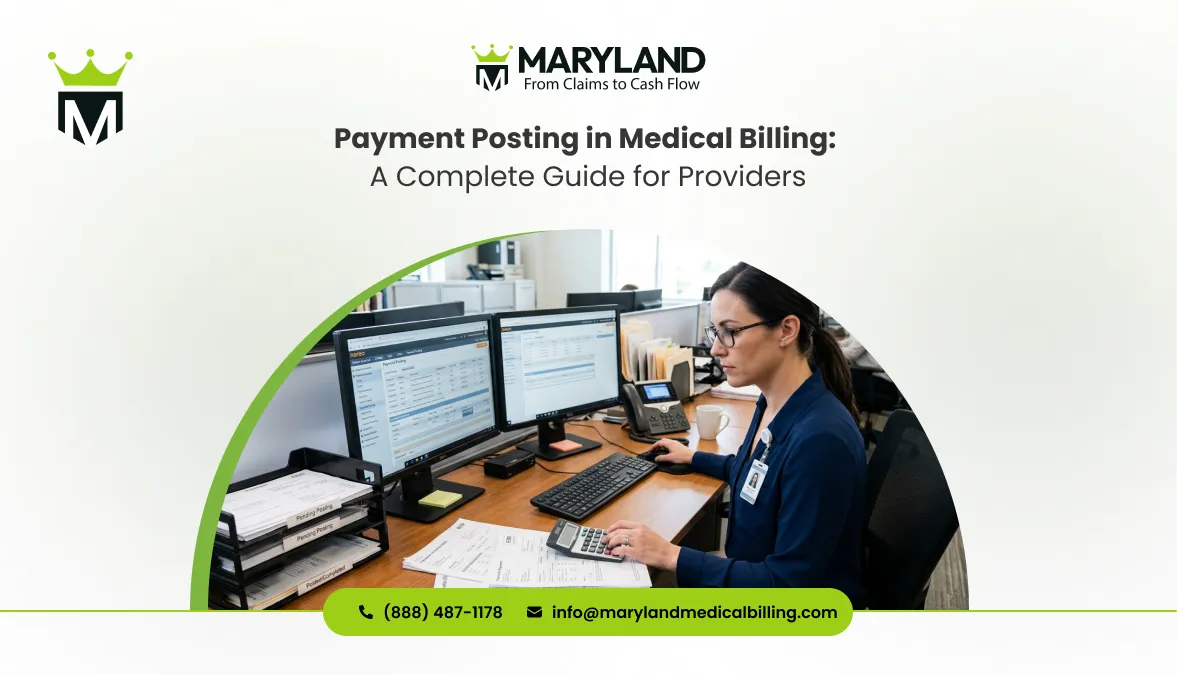
A payment may reach your bank account, but that does not necessarily mean the claim has been handled correctly.
One claim may be paid in full. Another may have a contractual adjustment. A third may leave a deductible for the patient, while another looks paid until someone notices that one procedure line was denied entirely.
That is where payment posting in medical billing becomes important.
Payment posting is the point where the payer’s final decision meets the provider’s accounts receivable. It shows how much was paid, what was adjusted, what remains the patient’s responsibility, what was denied, and whether further action is required.
For physicians, hospitals, clinics, and other healthcare providers, accurate payment posting provides much more than a clean ledger. It helps uncover underpayments, identify recurring denials, maintain correct patient balances, and show whether the revenue cycle is actually producing the reimbursement expected from submitted claims.
This guide explains how payment posting works, the role of ERA and EOB information, important CARCs and remark codes, relevant CPT and ICD-10 considerations, modifiers that commonly affect reimbursement, and the mistakes that can quietly create revenue problems.
Payment posting is the process of recording payments and adjustments received after a payer processes a healthcare claim.
When a payer adjudicates a claim, the result generally tells the provider:
For Medicare claims, CMS explains that providers generally receive either an Electronic Remittance Advice (ERA) or Standard Paper Remittance (SPR) containing final adjudication and payment information. The remittance also identifies adjustments made at the claim, service-line, or provider level.
Good payment posting means those details are transferred accurately into the provider’s practice-management or billing system and reconciled against the actual payment.
It is not simply:
Payment received → enter amount → close claim.
The better question is:
Did the payer process every claim line correctly, and does the remaining balance belong to the payer, provider, patient, or another responsible party?
That distinction matters.
Payment posting sits near the end of the claim cycle, but it can reveal problems that originated much earlier.
Suppose a physician bills $250 for a service. The payer allows $180 and pays $144 after applying $36 in patient coinsurance.
If the contract supports that calculation, the payment can be posted accordingly.
Now consider a different situation. The payer allows only $95 when the provider’s contracted rate should have been $180.
If staff simply post the $95 payment and adjust away the difference, a potential $85 underpayment disappears from accounts receivable.
Multiply similar errors across hundreds or thousands of claims and payment posting becomes a significant financial-control issue.
Accurate posting helps providers recognize:
Underpayments. Payments can be lower than the contracted rate even when the claim was technically “paid.”
Denials. A zero-dollar claim requires investigation rather than automatic closure.
Partial denials. One procedure line may be paid while another is denied.
Incorrect patient responsibility. Not every unpaid amount can legally or contractually be transferred to the patient.
Secondary payer balances. Medicare or another primary payer may process the claim while leaving an amount appropriate for secondary submission.
Recurring coding problems. Similar CPT, ICD-10, modifier, or authorization issues may repeatedly appear on remittances.
Payment posting therefore gives providers a practical view of what is happening after claims leave the practice.
Although workflows vary by organization and payer, the process generally follows several stages.
Payment may arrive through Electronic Funds Transfer (EFT), check, virtual card, or another payer-approved method.
The explanation of how claims were processed generally arrives through an ERA or EOB.
The payment and remittance are related, but they serve different purposes.
The payment tells you how much money arrived.
The remittance tells you why that amount was paid.
CMS notes that an ERA explains claim adjustments involving issues such as contractual arrangements, benefit coverage, secondary payers, copays, and coinsurance.
The amount deposited into the bank account needs to be connected with the corresponding remittance.
For electronic transactions, reassociation information helps connect EFT payments and ERA records.
CMS specifically identifies use of the payment-related TRN segment as part of the process used to match payments with remittance advice.
A mismatch should be investigated before the batch is considered completely reconciled.
Healthcare claims commonly contain several services.
For example:
| Service | Billed | Allowed | Paid | Patient Responsibility | Adjustment |
|---|---|---|---|---|---|
| Office visit | $180 | $135 | $108 | $27 | $45 |
| Procedure | $275 | $210 | $168 | $42 | $65 |
| Lab service | $70 | $50 | $0 | $0 | $70 denied |
Posting only the total payment would hide the fact that the laboratory service was denied.
Each claim line should therefore be reviewed according to the payer’s adjudication.
The difference between the provider’s charge and the payer’s contracted allowable amount may represent a contractual adjustment.
For example:
Billed charge: $300
Contracted allowable: $210
Contractual adjustment: $90
Payer payment after patient coinsurance: $168
Patient responsibility: $42
The $90 should not automatically become a patient balance when the provider’s agreement requires it to be written off.
Incorrectly moving contractual adjustments to patients can create inaccurate statements and compliance concerns.
Patient responsibility commonly includes:
The remittance group code is particularly important here.
CMS explains that PR generally identifies patient responsibility, while CO indicates contractual obligation or provider responsibility.
That distinction should be respected before a balance is transferred to the patient ledger.
Several abbreviations appear frequently in payment posting.
The ERA is the electronic record showing how claims were adjudicated.
It can include:
An EOB provides claim-processing information showing how a payer handled the claim. Depending on the payer and workflow, providers may review EOB information when electronic remittance is unavailable or additional clarification is required.
EFT is the movement of the actual payment into the provider’s bank account.
An ERA explains the payment.
An EFT delivers the money.
CARCs explain the financial reason a claim or service was adjusted.
RARCs provide additional information that can further explain an adjustment or communicate information not completely expressed by the CARC.
Under HIPAA administrative simplification requirements, standardized CARCs and RARCs are used to communicate claim-payment adjustments. CMS notes that these code sets are maintained through recognized standards processes and are updated periodically.
Before interpreting the numerical CARC, staff should look at the accompanying group code.
| Group Code | General Meaning |
|---|---|
| CO | Contractual Obligation |
| PR | Patient Responsibility |
| OA | Other Adjustment |
| PI | Payer-Initiated Reduction |
The same adjustment reason can sometimes have different financial consequences depending on the group code.
For that reason, reading only the CARC number without considering the group code can lead to incorrect balance transfers or write-offs.
Providers may see hundreds of possible combinations depending on the payer and claim. The following examples are commonly encountered and help illustrate how payment posting connects with denial management.
This generally represents an amount applied to the patient’s deductible.
When correctly assigned as patient responsibility, it may be transferred to the patient balance after verifying insurance sequencing and secondary coverage.
This identifies an amount assigned as coinsurance.
The amount should be reviewed before billing the patient, particularly when secondary insurance exists.
This relates to the patient’s copayment obligation.
Posting should account for any amount already collected at the time of service.
CARC 16 generally indicates that the claim or service lacks information or contains a submission/billing error required for adjudication.
A remark code should typically provide greater detail about what is missing or invalid.
Possible causes include:
This is a good example of why payment posters should not stop at the CARC. The accompanying RARC often points toward the actual correction required.
CARC 18 generally indicates an exact duplicate claim or service.
Before submitting another claim, staff should review:
Repeatedly resubmitting the same claim can make the problem worse.
This adjustment commonly appears when the billed amount exceeds the payer’s fee schedule, maximum allowable amount, contracted rate, or another applicable payment arrangement.
Example:
Provider charge: $240
Payer allowable: $175
Adjustment: $65
If $175 is the correct contracted amount, the $65 may represent the contractual adjustment.
But payment posters should still verify contract terms when the allowable appears lower than expected.
CARC 50 is associated with a service the payer considers not medically necessary under its applicable criteria.
These denials may require review of:
A medically necessary service can still be denied when the submitted diagnosis does not support the procedure under the payer’s policy.
CARC 96 generally identifies a noncovered charge and should be accompanied by additional information explaining the reason when required.
Do not automatically move every CO-96 balance to the patient.
Responsibility depends on the group code, payer policy, benefit rules, contractual requirements, and any applicable patient notification requirements.
A CARC often gives the broad reason for an adjustment. A RARC provides more detail.
For instance, an ERA might indicate that a claim lacks necessary information. The related remark code may identify the specific field, documentation element, procedure description, or policy issue involved.
CMS describes RARCs as codes that further explain adjustments or communicate information that cannot be adequately expressed through a CARC alone.
That is why a payment poster should examine the entire combination:
Group Code + CARC + RARC + payer policy + original claim
rather than reacting to a single code.
CMS also updates the CARC/RARC environment periodically, so practices should avoid relying indefinitely on old internal denial-code spreadsheets.
No dedicated CPT or ICD-10-CM code exists for the administrative task of payment posting itself.
This distinction is important.
CPT codes describe medical services and procedures.
ICD-10-CM codes describe diagnoses, conditions, symptoms, and reasons for encounters.
HCPCS codes report various healthcare services, supplies, drugs, equipment, and other items when applicable.
CARCs and RARCs explain payment adjustments after a claim has been processed.
The AMA describes CPT as a standardized system of five-digit codes for reporting medical procedures and services performed by physicians and other qualified healthcare professionals.
Payment posting nevertheless depends heavily on CPT, HCPCS, ICD-10-CM, and modifier accuracy because these codes influence how the payer adjudicates the underlying claim.
Imagine a remittance containing these common categories of services:
| Service Category | Example CPT Codes |
|---|---|
| Established office/outpatient E/M | 99211–99215 |
| New patient office/outpatient E/M | 99202–99205 |
| Preventive medicine services | 99381–99397 |
| ECG | 93000 and related codes |
| Chest X-ray | 71045–71048 |
| Physical therapy | 97110, 97112, 97140 |
| Laboratory testing | Codes vary by test |
| Minor procedures | Procedure-specific CPT codes |
These are not “payment posting codes.” They are examples of services whose reimbursement may need to be reconciled during payment posting.
The AMA maintains and updates CPT annually. The 2026 CPT code set is the applicable annual set for 2026 services as appropriate, while CPT 2027 becomes effective January 1, 2027. The AMA released the 2027 code set in September 2026.
Providers should always verify the code applicable to the date of service rather than relying on an outdated internal list.
Diagnosis codes can have a major effect on whether a procedure is considered payable.
Examples include:
| Condition | Example ICD-10-CM Code |
|---|---|
| Essential hypertension | I10 |
| Type 2 diabetes mellitus without complications | E11.9 |
| Gastroesophageal reflux disease without esophagitis | K21.9 |
| Low back pain | M54.50 |
| Right knee pain | M25.561 |
| Generalized anxiety disorder | F41.1 |
| Major depressive disorder | Code depends on type/severity/remission status |
A submitted CPT code might be correct, but the claim can still encounter coverage issues if the diagnosis does not support medical necessity under the payer’s applicable policy.
Payment posters should therefore identify patterns such as:
same CPT + same diagnosis + repeated denial
That pattern should be communicated upstream for coding and documentation review rather than repeatedly adjusted off.
As of September 2026, FY 2026 ICD-10-CM files apply through September 30, 2026. CMS has also published FY 2027 ICD-10 resources for the new fiscal year beginning October 1, 2026.
Modifiers provide additional information about how, where, or under what circumstances a service was performed.
A missing or inappropriate modifier can change reimbursement or trigger a denial.
Common examples include:
| Modifier | Common Purpose |
|---|---|
| 25 | Significant, separately identifiable E/M service on the same day as another procedure/service |
| 26 | Professional component |
| TC | Technical component |
| 50 | Bilateral procedure |
| 51 | Multiple procedures |
| 52 | Reduced services |
| 53 | Discontinued procedure |
| 59 | Distinct procedural service when appropriate |
| 76 | Repeat procedure by same physician/QHP |
| 77 | Repeat procedure by another physician/QHP |
| 78 | Related procedure during postoperative period |
| 79 | Unrelated procedure during postoperative period |
| 91 | Repeat clinical diagnostic laboratory test |
| GA | Medicare waiver-of-liability circumstances when applicable |
| GY | Item/service statutorily excluded or not meeting Medicare benefit definition when applicable |
| GZ | Service expected to be denied as not reasonable and necessary when applicable |
Modifiers should never be added merely to obtain payment.
They must accurately describe the documented service and meet the applicable payer and coding requirements.
During payment posting, modifier-related denial trends can reveal a broader claim-submission problem that needs correction before additional claims are sent.
Consider the following claim:
CPT 99214
Charge: $220
CPT 93000
Charge: $95
Total billed: $315
The payer processes the claim and allows:
99214 → $155
93000 → $70
Total allowed: $225
Suppose the patient has 20% coinsurance.
Payer responsibility:
$225 × 80% = $180
Patient coinsurance:
$225 × 20% = $45
Contractual adjustment:
$315 − $225 = $90
Correct posting would therefore reflect:
Payer payment: $180
Patient responsibility: $45
Contractual adjustment: $90
Remaining unexplained payer balance: $0
The claim should not simply be marked “paid $180.”
Each part of the original $315 charge must be accounted for.
A claim can appear paid even when part of it has been denied.
Consider:
99214 — paid
93000 — denied
36415 — paid
If the payment poster closes the entire claim because money was received, the unpaid ECG service may never reach denial follow-up.
For that reason, payment posting should occur at the service-line level whenever the remittance provides line-level adjudication information.
This is one of the simplest ways to prevent recoverable revenue from disappearing into adjustments.
Not every difference between charges and payment is contractual.
Part of the amount could represent:
Automatic write-offs can therefore hide collectible revenue.
A balance associated with a contractual obligation should not automatically become patient responsibility.
The group code and payer contract should be reviewed before a balance is transferred.
CMS specifically distinguishes CO contractual obligations from PR patient responsibility.
CARC 16 by itself does not necessarily tell staff exactly what to correct.
The associated RARC may identify the missing or invalid element.
Ignoring it can result in the same unsuccessful resubmission several times.
A payer can issue payment and still underpay a claim.
The posted payment should be compared with the expected contractual allowance whenever reliable fee-schedule information is available.
A denied claim does not automatically equal lost revenue.
Some denials can be corrected or appealed.
Examples may involve:
The denial reason should determine the next step.
Payment posting identifies the payer’s decision.
Denial management determines what should happen next.
A useful workflow looks like this:
Claim submitted → payer adjudication → ERA received → payment posted → adjustment analyzed → denial categorized → correction/appeal when appropriate → account reconciled
When these functions operate separately, important information can be lost.
For example, payment-posting data may reveal that a clinic receives repeated denials for a particular procedure because authorization information is missing.
Fixing only individual claims treats the symptom.
Correcting the authorization workflow addresses the source.
Underpayment does not always arrive with the word “DENIED.”
A claim may be paid at an unexpectedly low amount.
Providers should compare:
Expected allowed amount vs. actual allowed amount
and
Expected reimbursement vs. actual reimbursement
Suppose a contracted service should allow $150.
Payer allowed amount: $118.
Potential variance: $32
If the $32 is automatically posted as an adjustment, the account balances mathematically—but the provider may have been underpaid.
Payment posting therefore works best when payer contract information is available for comparison.
Coordination of benefits can make posting more complicated.
If Medicare or another payer processes the claim first, the remaining deductible or coinsurance may need to move to secondary insurance rather than directly to the patient.
A good posting workflow verifies:
Sending statements before this process is complete can create patient confusion and unnecessary collection work.
Many modern billing systems can automatically process ERA information.
Automation can improve efficiency, particularly for clean and predictable payment transactions.
However, automation does not eliminate the need for exceptions.
Manual review may still be necessary when the system detects:
The strongest workflow is usually not “manual versus automated.”
It is automation for predictable transactions combined with focused human review for exceptions.
Before a payment batch is considered complete, the practice should be able to answer a few basic questions:
Does the deposit match the payer payment?
Does the payment correspond to the correct ERA or EOB?
Was each service line posted correctly?
Were contractual adjustments separated from patient responsibility?
Were CARCs and RARCs reviewed?
Were denied lines transferred to appropriate follow-up?
Were secondary payer balances identified?
Were unusual underpayments flagged?
Were recoupments or take-backs recorded correctly?
Does the remaining accounts receivable balance make sense?
A balanced batch is important, but a balanced batch is not necessarily an accurately adjudicated batch.
The most effective improvement is to treat payment posting as part of revenue-cycle analysis rather than isolated data entry.
Practices should maintain current payer fee schedules where practical, establish clear adjustment categories, monitor high-value denials, compare expected and actual reimbursement, and route unresolved balances promptly.
The practice should also periodically review payment trends by:
Patterns become much easier to identify when payment information is analyzed consistently.
For example, if one payer repeatedly reduces the same procedure, the issue may require contract review.
If multiple payers deny the same CPT/diagnosis combination, the coding or medical-necessity workflow may need attention.
If one location shows unusually high patient balances, eligibility or benefit verification may be contributing to the problem.
Payment posting provides the data needed to see these patterns.
Payment posting has a direct effect on A/R accuracy.
When payments are posted late, paid claims may continue appearing as outstanding.
When contractual adjustments are missed, A/R may look artificially high.
When payer balances are written off incorrectly, A/R may look artificially low.
When patient responsibility is not transferred properly, patient statements may be wrong.
When partial denials are overlooked, recoverable payer balances may disappear.
For physicians and healthcare organizations reviewing revenue-cycle performance, this means A/R reports are only as trustworthy as the transactions entered into the underlying accounts.
Medical coding changes continuously, so payment-posting procedures should not rely on static code references.
For ICD-10-CM, CMS indicates that FY 2026 codes cover the applicable 2026 periods, with FY 2027 code resources becoming applicable beginning October 1, 2026.
For CPT, the AMA has released the CPT 2027 code set, which becomes effective January 1, 2027. The AMA reports that the 2027 release includes 299 new codes among its revisions.
CARCs and RARCs also receive periodic updates. CMS issued a July 2026 update and has additional Medicare implementation activity scheduled for October 2026.
For providers, the practical lesson is simple: denial tables, procedure lists, diagnosis references, and remittance workflows should be reviewed regularly instead of being treated as permanent.
It is easy to think of payment posting as one of the simpler steps in medical billing.
A payer sends money. Someone records it.
In reality, the important work happens between those two sentences.
The posting process determines whether contractual adjustments are recognized correctly, patient responsibility is assigned properly, denied claims remain visible, secondary balances move to the right payer, and underpayments are identified rather than quietly written off.
CPT, HCPCS, ICD-10-CM, and modifiers influence how claims reach adjudication. CARCs, RARCs, group codes, ERA information, and payer policies help explain what happened afterward.
Providers that connect these pieces gain something more useful than a balanced payment batch: they gain a clearer picture of where their reimbursement is being earned, reduced, delayed, or lost.
Accurate payment posting in medical billing is one of the foundations of a reliable revenue cycle. A clean claim may bring in payment, but only careful reconciliation can confirm whether that payment is correct.
Physicians, hospitals, and clinics should pay particular attention to service-line payments, contractual allowances, patient responsibility, CARCs, RARCs, modifiers, coding-related denials, secondary coverage, and unexpected reimbursement variances.
The goal should not simply be to make an account balance reach zero.
The goal is to understand why every dollar was paid, adjusted, denied, transferred, or left outstanding.
When payment posting is handled with that level of accuracy, it becomes more than an administrative step. It becomes an important control for protecting revenue, improving denial visibility, maintaining accurate patient accounts, and strengthening the overall financial performance of the practice.